
Industry: Dental & Oral Healthcare
Location: Australia
Website: Bradbury Dental Surgery
Campaign: Technical SEO, Content Optimization & Local SEO
Measurement Period: October 2025 – November 2026
Project Overview
When we started working on this dental website, the biggest challenge wasn’t simply a lack of content or backlinks. The website had several underlying SEO issues that were limiting its performance in organic search.
There were technical problems, keyword cannibalization, content sections that added length without adding value, over-optimised internal linking, and gaps in topical coverage around the practice’s dental services.
We also needed to make sure the website provided a consistent experience across devices. Rankings are only part of the job. Visitors should be able to use every page properly, whether they are browsing on a mobile phone or a desktop.
Instead of publishing more articles just to increase the website’s content volume, we took a different approach.
We focused on fixing the existing problems, improving the quality and relevance of the content, building a clearer topical structure, and checking the website’s experience across devices.
The objective was straightforward: improve organic search visibility and attract more people searching for dental services.
Results at a Glance
The following figures compare October 4 to November 3, 2025, with October 4 to November 3, 2026.
| Performance Metric | Before | After | Change |
|---|---|---|---|
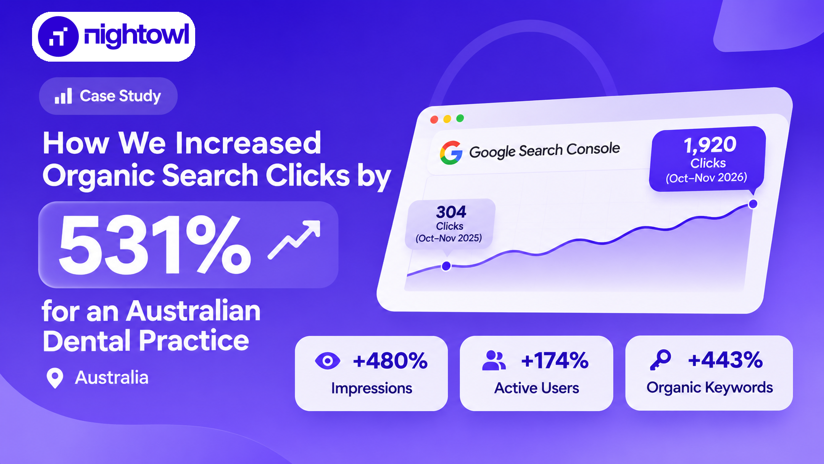
| Google Search Clicks | 304 | 1,920 | +531% |
| Google Search Impressions | 52,200 | 303,000 | +480% |
| Average Search Position | 15.2 | 8.7 | Improved by 6.5 positions |
| GA4 Active Users | 767 | 2,100 | +174% |
| GA4 New Users | 717 | 2,100 | +193% |
| Average Engagement Time | 1m 04s | 1m 19s | +23% |
Additional SEMrush data:
- Estimated organic traffic increased from 565 to 5,400, approximately
+856%. - Organic keyword rankings increased from 460 to 2,500, approximately
+443%. - Referring domains remained at 364.
- Total backlinks remained at approximately 6,000.
Google Search Console, GA4, and SEMrush measure different things.
SEMrush traffic is an estimate. Google Search Console clicks and GA4 users are reported by their respective platforms. Growth percentages are calculated from the figures shown in the reports.
1. Understanding the Challenges
Before making changes, we needed to understand why the website wasn’t reaching its full organic search potential.
Our initial review identified several areas that needed attention.
Technical SEO Issues
Technical problems can make it harder for search engines to crawl, understand, and index important pages.
We identified and fixed the technical issues affecting the website. The aim was to give search engines clear access to the important pages and remove unnecessary technical obstacles.
Keyword Cannibalization
Some pages were targeting similar search queries and overlapping search intent.
This made it harder to establish a clear primary page for certain topics. Rather than creating more pages, we reviewed the existing content, identified overlap, and worked to give each important page a clearer purpose.
Over-Optimised Internal Linking and Forced Anchor Text
Another issue was the way internal links had been added across the website.
Primary keywords were repeatedly forced into anchor text, even when they did not fit naturally into the sentence. In some cases, the same primary keyword appeared as the anchor text for two or three internal links on a single page.
This created an unnatural linking pattern. Repeating exact-match commercial keywords does not automatically improve rankings. Internal links should help visitors find related information and make the relationship between pages clear.
We needed to make the linking structure more relevant and natural.
Content Without Real Value
Some content sections appeared to have been added mainly to increase word count.
Longer content is not automatically better. Several sections were unnecessarily lengthy and did not give potential patients useful information.
We reviewed these sections and removed material that did not help answer the user’s questions or support the purpose of the page.
Every section needed a clear reason to be there.
Weak Internal Linking Structure
Apart from the forced anchor text, the website needed a more organised internal linking structure.
Important service pages and supporting articles needed stronger contextual connections. Related pages should help visitors move naturally from one useful piece of information to another.
Limited Topical Coverage
The website needed better coverage of topics related to its core dental services.
Publishing individual blog posts without a wider plan was not enough. We needed a topical map that connected the main service pages with relevant supporting topics.
2. What We Did to Improve Organic Search Performance
We did not approach this project by publishing as much content as possible or building backlinks without a clear reason.
We focused on the website’s existing problems, the quality of its content and the way its pages worked together.
1. Fixed Technical SEO Issues
We started by addressing the technical problems found during the website review.
Our work focused on the technical elements affecting crawlability, indexability, and the website’s overall structure.
We fixed the identified issues to give the content and other optimisation work a better foundation.
If your website is still struggling after SEO work, our guide on why a website may not rank after SEO covers some of the issues worth investigating.
2. Resolved Keyword Cannibalization
We reviewed pages targeting similar or overlapping search queries.
Where multiple pages were competing for the same search intent, we worked on improving their differentiation and reducing unnecessary overlap.
Our work included:
- Identifying pages targeting similar keywords and search intent.
- Reviewing the purpose of each competing page.
- Improving content differentiation.
- Strengthening the relevance of primary service pages.
- Making the relationship between related topics clearer.
The goal was not to reduce the number of pages. It was to make sure every important page had a clear purpose.
3. Improved Existing Content Quality
We revisited existing pages and improved their content based on search intent and what potential patients would find useful.
Instead of focusing on keyword density or arbitrary word counts, we worked on making the information clearer and more relevant.
This included improving explanations, removing repetition, filling information gaps, and making sure important details were covered.
We also removed sections that had been added simply to increase word count.
Our approach was simple: every paragraph should serve a purpose.
For a closer look at how we approach content planning, see our content blueprint for AI answers and organic search.
4. Built a Topical Authority Map
We mapped the website’s core dental services and identified supporting topics that could improve its coverage of each subject.
Rather than treating every blog post as a separate piece of content, we grouped related topics into clusters.
The structure focused on:
- Core dental service pages.
- Supporting educational articles.
- Relevant dental conditions and treatments.
- Common patient questions.
- Related informational search queries.
We then developed supporting content around these topics.
This gave service pages and supporting articles clearer topical relationships. The aim was to cover subjects relevant to the dental practice, not simply to increase the number of indexed URLs.
Useful topical coverage also depends on giving visitors accurate, relevant information. Our guide to E-E-A-T and improving SEO traffic explains how experience, expertise, authoritativeness, and trust fit into content quality.
5. Rebuilt the Internal Linking Structure
We did not just add more internal links. We also corrected how existing links were being used.
Some pages contained two or three internal links using the same primary keyword as anchor text. We reviewed this approach and made the linking structure more natural and relevant to the surrounding content.
Our work included:
- Removing unnecessary and repetitive exact-match anchor text.
- Avoiding multiple links to the same destination where they served no
clear purpose. - Using descriptive anchor text that fit the sentence.
- Connecting supporting articles with relevant service pages.
- Linking related content based on topic and user needs.
- Making sure links helped visitors reach useful information.
We did not remove keyword-rich anchor text altogether. We used it where it made sense and varied the wording where a more natural description was better.
The aim was to create useful connections between pages, not to force primary keywords into every available link.
6. Reviewed Every Page on Mobile and Desktop
We also checked every page on both mobile and desktop devices.
This was not limited to checking whether the website was responsive. We went through the pages to see whether the design was consistent, the content was easy to read, and the website elements worked as expected.
We reviewed:
- Mobile friendliness: How each page appeared and worked on mobile
screens. - Design consistency: Layouts, spacing, alignment and visual
presentation across pages. - Text consistency: Font styles, heading formats, text sizes,
readability and content formatting. - Element functionality: Whether buttons, links, forms and other
interactive elements worked as expected. - Page layout: How sections appeared on desktop and mobile,
including any display or usability issues. - Navigation: Whether visitors could move between important pages
and find information without difficulty.
The goal was to provide a consistent experience regardless of the device being used.
There is little value in bringing more visitors to a website if they encounter broken elements, inconsistent layouts, or pages that are difficult to use.
7. Maintained NAP Consistency Across the Internet
For a local dental business, consistent business information is an important part of local SEO.
We reviewed the business information shown across relevant online directories and listings, focusing on:
- Business name.
- Address.
- Phone number.
- Other business details where applicable.
Consistent information helps avoid confusion about the business’s identity and location. It is an important part of maintaining a reliable local search presence.
8. Refreshed Older Content
We did not ignore the existing content library.
Older articles and pages were reviewed to find information that was outdated, incomplete, or no longer useful.
The work included:
- Updating outdated information.
- Improving explanations.
- Adding relevant missing information.
- Removing repetitive sections.
- Improving internal links.
- Matching content more closely to current search intent.
This allowed us to improve existing pages rather than relying entirely on new content.
3. The Results: One Year of Organic Search Growth
After the work was implemented, the website showed improvements across Google Search Console, Google Analytics 4, and SEMrush.
The following sections show the figures from each platform.
Google Search Console: Organic Clicks Increased by 531%
We compared two equivalent 30-day periods:
- Before: October 4 to November 3, 2025.
- After: October 4 to November 3, 2026.
| Metric | October-November 2025 | October-November 2026 |
|---|---|---|
| Total Clicks | 304 | 1,920 |
| Total Impressions | 52.2K | 303K |
| Average CTR | 0.6% | 0.6% |
| Average Position | 15.2 | 8.7 |
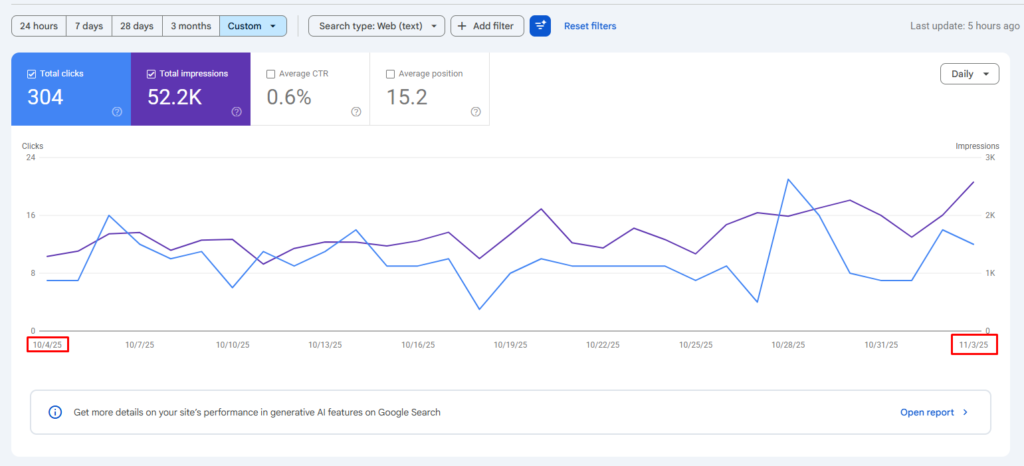
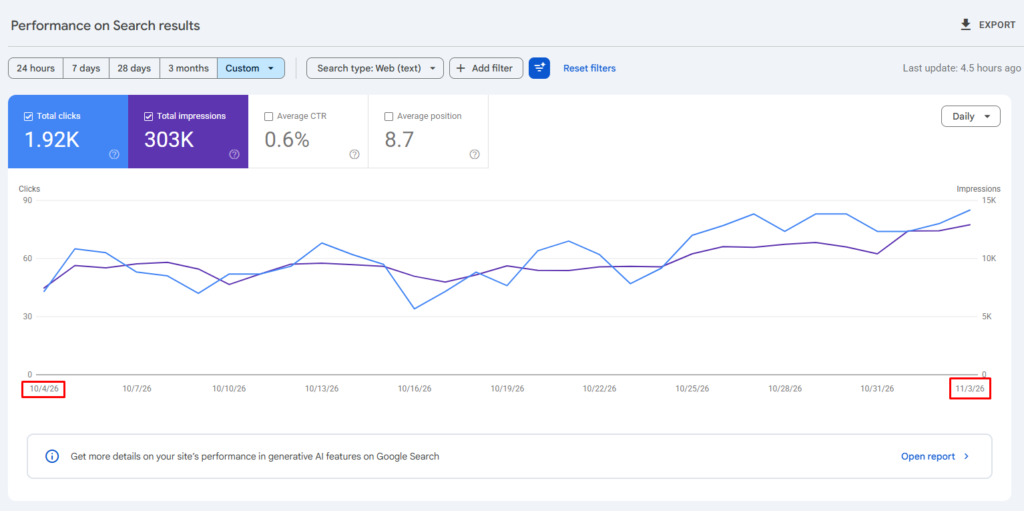
The website went from generating just over 300 organic clicks to nearly 2,000 clicks in the comparison period.
Search impressions increased from 52,200 to 303,000. Average search position also improved from 15.2 to 8.7.
The website gained substantially more visibility across Google Search and improved its average position.
CTR remained at 0.6%, so this is still an area we can work on. Better page titles, descriptions, and search-result relevance may help turn a larger share of impressions into clicks.
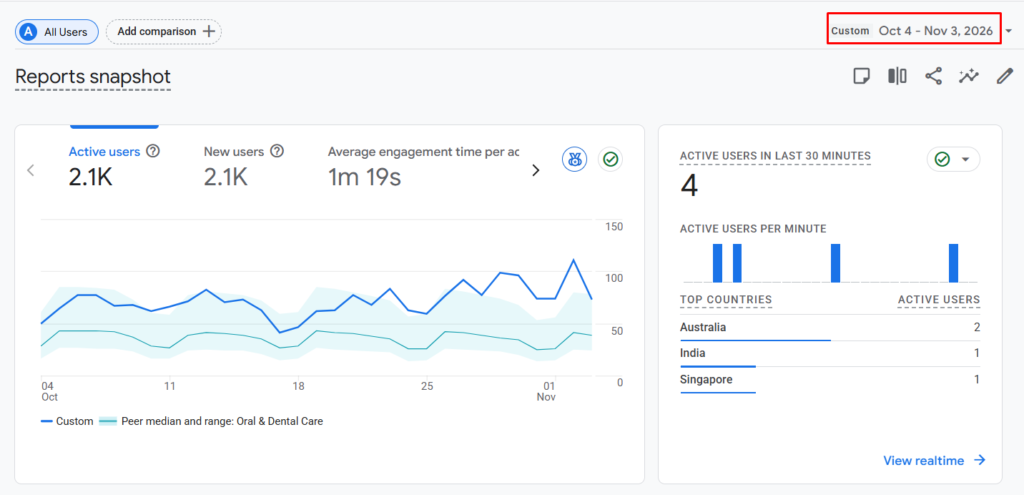
Google Analytics 4: Growth in Website Users
We also reviewed GA4 to understand how the website’s audience changed.
The comparison covers October 4 to November 3 in both years.
| Metric | Before | After |
|---|---|---|
| Active Users | 767 | 2,100 |
| New Users | 717 | 2,100 |
| Average Engagement Time | 1m 04s | 1m 19s |
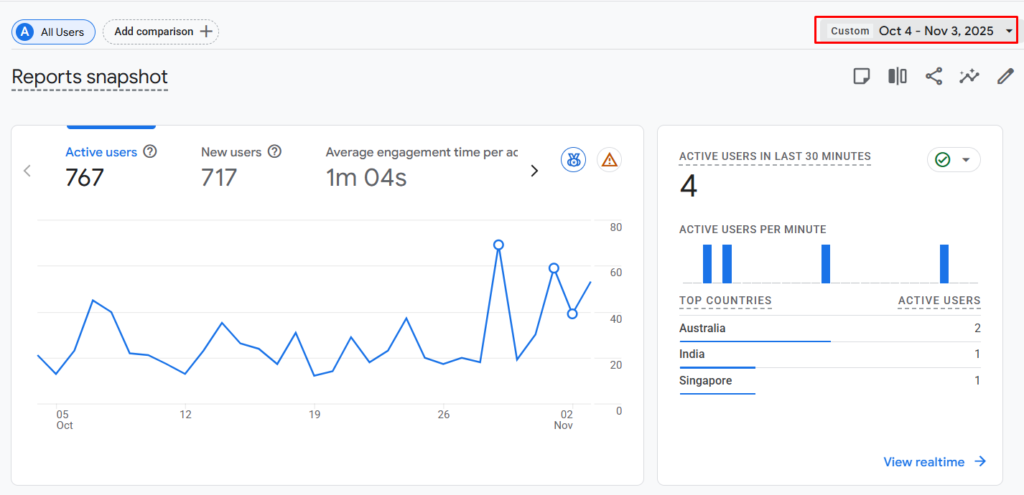
The website recorded:
- 174% growth in active users.
- 193% growth in new users.
- 23% improvement in average engagement time.
The increase in new users shows that the website reached a larger audience during the comparison period.
Average engagement time increased from 1 minute and 4 seconds to 1 minute and 19 seconds.
These GA4 figures represent the users shown in the reports, not organic users alone. Engagement time is also not proof of appointment bookings or enquiries.
SEMrush: Growth in Estimated Organic Traffic and Keywords
We also used SEMrush to review the website’s estimated organic traffic and keyword visibility.
The November 2025 and November 2026 snapshots showed:
| Metric | November 2025 | November 2026 |
|---|---|---|
| Estimated Organic Traffic | 565 | 5.4K |
| Organic Keywords | 460 | 2.5K |
| Authority Score | 18 | 18 |
| Referring Domains | 364 | 364 |
| Backlinks | 6K | 6K |
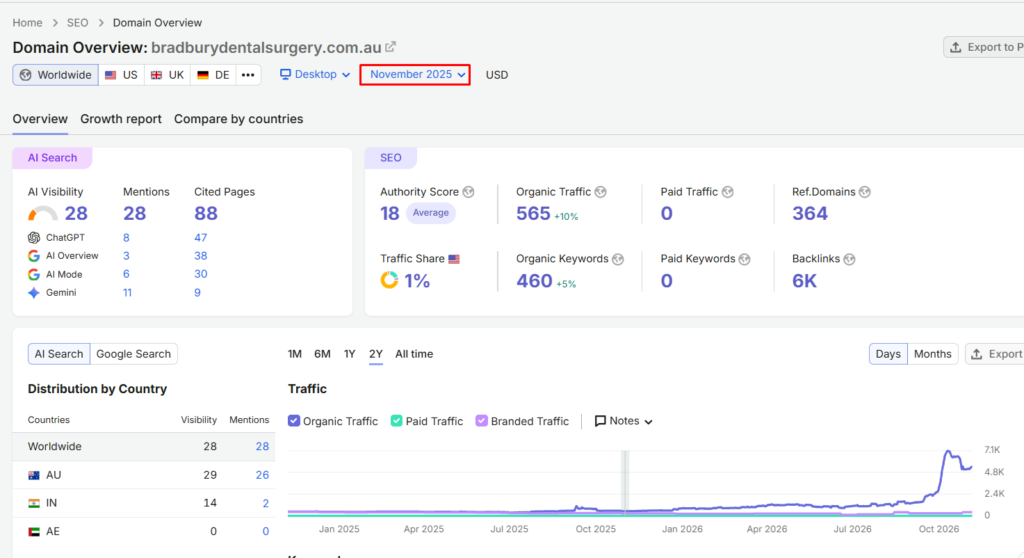
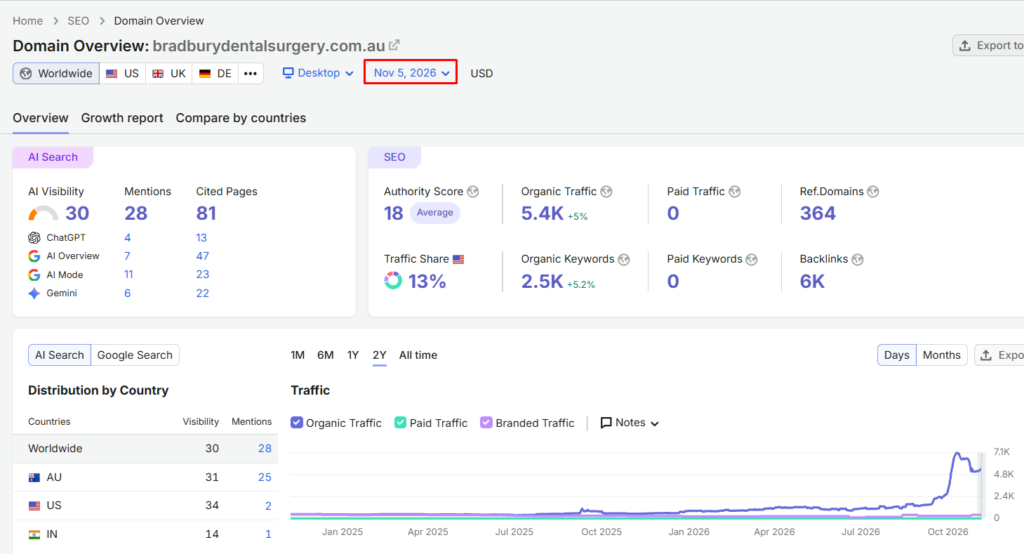
Estimated organic traffic increased from 565 to 5,400, approximately 856%.
The number of organic keywords increased from 460 to 2,500, approximately 443%.
One point worth noting is that the referring domain and backlink counts remained approximately the same in both snapshots.
The website’s estimated organic traffic and keyword visibility increased without a corresponding increase in these reported link metrics.
Our work focused on technical SEO, content quality, topical coverage, internal linking, and local SEO rather than using backlink acquisition as the main growth strategy.
SEMrush figures are third-party estimates, not actual website traffic. They should be considered separately from Google Search Console and GA4 data.
4. Additional Progress in AI Search Visibility
We also reviewed the website’s visibility across AI-powered search platforms using SEMrush’s AI Search reporting.
The November 2026 snapshot showed:
- AI Visibility Score: 30.
- Total AI Mentions: 28.
- Cited Pages: 81.
- ChatGPT Mentions: 4.
- Google AI Overview Mentions: 7.
- Google AI Mode Mentions: 11.
- Gemini Mentions: 6.
Compared with November 2025, the AI Visibility Score increased from 28 to 30.
However, total mentions remained at 28, while cited pages decreased from 88 to 81.
There is still work to do to increase the number of mentions and pages cited across these platforms. We are treating this as an area for further improvement, not claiming it as a major result of the campaign.
Businesses looking to improve their visibility across traditional search and AI-powered platforms can also explore our AI SEO services.
5. What Made the Difference?
Looking back at the work completed, the main lesson is that SEO growth does not always require publishing more content or continuously acquiring backlinks.
The website already had content and an existing backlink profile. What it needed was a better-organised website structure, more useful content, and a clearer internal linking approach.
We focused on the issues that were limiting its performance:
- Technical problems affecting the website’s SEO foundation. 2. Keyword cannibalization between pages. 3. Content sections that added length without adding value. 4. Internal links relying too heavily on forced exact-match anchor
text. 5. Gaps in topical coverage around the practice’s core services. 6. Older content that needed updating. 7. Mobile and desktop pages that needed a thorough review. 8. Business information that needed to remain consistent across the
internet.
We treated these as connected parts of the same project rather than isolated SEO tasks.
6. Key Takeaways
This project reinforced a few practical SEO lessons.
More content is not always better. Publishing articles without a clear purpose can create unnecessary complexity. Improving existing content can be a better use of time.
Technical SEO matters. A website needs a sound technical structure so search engines can access and understand its important pages.
Topical coverage needs a plan. Publishing related articles is not enough. Service pages, supporting content, and internal links need to fit together.
Internal links should be natural. Repeating exact-match anchor text across a website is not a substitute for a useful linking structure.
Check the website on real devices. Every page should be readable and functional on mobile and desktop. Design consistency, working elements, and clear navigation matter.
Local SEO needs accurate business information. Consistent business details across relevant listings help maintain a reliable local presence.
Traffic is not the only SEO KPI. Clicks and visits matter, but they do not tell the whole story. We discuss this further in our article on why traffic is no longer the best SEO KPI.
Final Thoughts
Over the course of this project, we improved the website’s organic search performance through technical fixes, content improvements, topical planning, internal linking, mobile and desktop reviews, and local SEO work.
The results included:
- 531% more Google Search clicks.
- 480% more Google Search impressions.
- 174% more GA4 active users.
- 443% growth in estimated organic keyword rankings.
- 856% growth in estimated organic traffic.
The biggest part of the work was not one particular SEO technique. It was finding the problems, fixing them, and making sure the website’s pages worked together.
Our approach is simple: do not publish more just for the sake of it. Build a better website, publish useful information, and make it easier for visitors and search engines to understand what the business offers.
You can also explore our other SEO case studies to see how we have approached organic search challenges across different industries.
Want to Improve Your Website’s Organic Search Performance?
At Nightowl, we help businesses improve their organic visibility through technical SEO, content strategy, local SEO, and ongoing website optimisation.
If your website has stagnant rankings, declining traffic, keyword cannibalization, or technical problems, we can review what’s holding it back.
Explore our SEO services or view our SEO pricing to learn more.
