
Most content today has a visibility problem.
Not because it is bad.
Not because it lacks keywords.
But because it was written for ranking, not for selection.
Search engines and AI systems no longer reward pages just for existing. They reward pages that reduce uncertainty, complete intent, and can be safely reused as answers.
That is why many pages rank… but never get cited by AI.
And why some pages with lower rankings are repeatedly surfaced in AI answers.
In this guide, I will break down the exact content optimization parameters that actually improve search performance and AI discoverability, based on how modern retrieval systems evaluate content, not SEO myths.
This is not a theory. This is how content gets selected.
What You Will Learn in This Guide
If you read this from top to bottom, you will understand:
- Why entity clarity matters more than keywords
- How AI decides whether your content completes search intent
- What “topic completeness” actually means in practice
- How structure impacts AI confidence and extraction
- Why vague content is silently ignored
- How to write content that is quote-ready
- Why originality and constraints increase trust
- How brands become entities in AI systems
You can use this as:
- A writing framework
- A content audit checklist
- A standard for AI-optimized content
Now, let us break it down step by step.
Step 1: Define the Primary Entity Clearly and Early
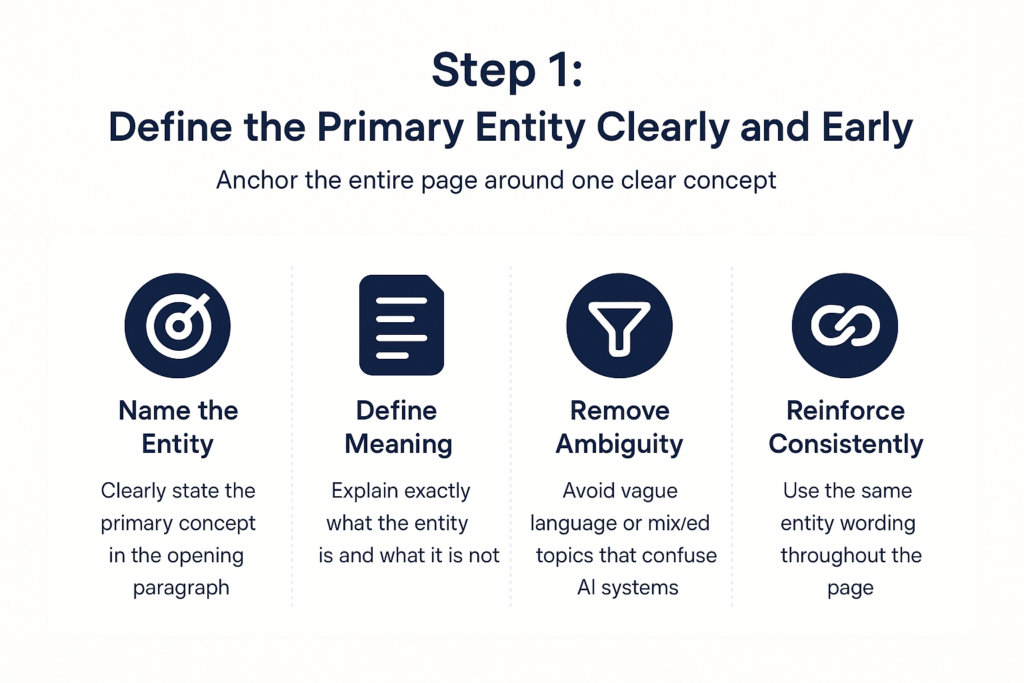
This step means committing to one primary concept and anchoring the entire page around it from the opening paragraph. You are not teasing the topic or circling it. You are naming it directly, defining it, and reinforcing it consistently so both users and AI systems know exactly what the page represents.
How to execute this step
- Name the primary concept explicitly in the opening paragraph
- Define what it is and what it is not
- Reinforce the same entity wording throughout the page
Example:
If the page is about AI content discoverability, the introduction should explicitly define what AI content discoverability means, how it differs from traditional SEO, and what systems it applies to within the first 150 words.
Why this matters:
Search engines and AI systems index entities, not pages.
If your entity graph is weak or inconsistent, nothing else on the page can fix it.
If someone reads just one paragraph from your page and cannot clearly identify the entity, your content is already losing.
Step 2: Fully Satisfy the Primary Search Intent
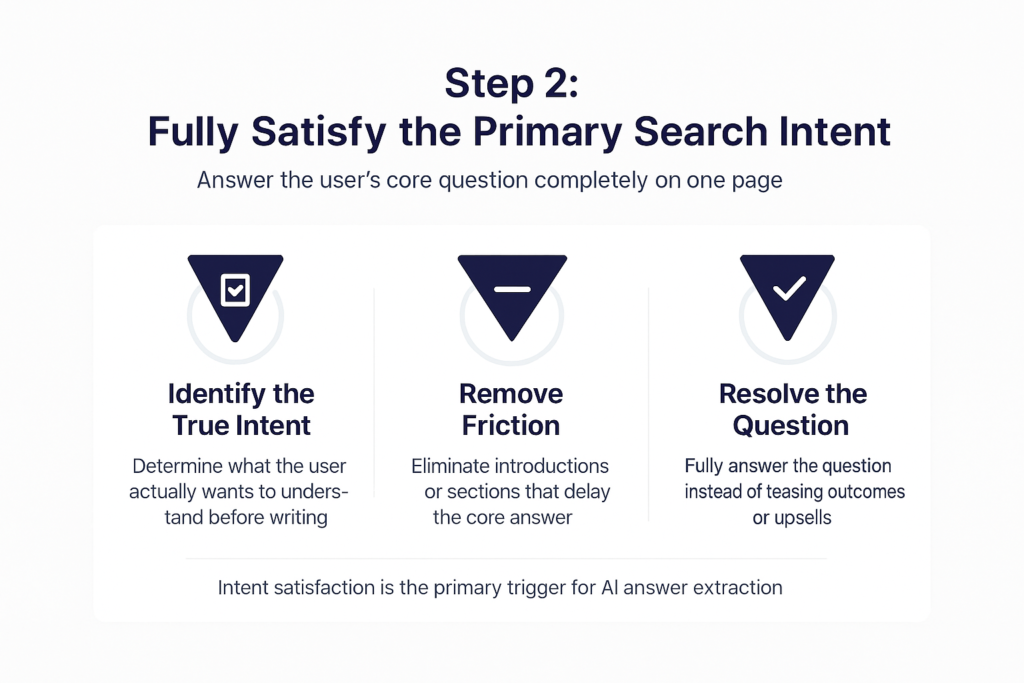
Satisfying intent means answering the user’s core question completely on one page, without forcing them to search again for clarification. This requires identifying what the user truly wants to understand, not what you want to promote or rank for.
How to execute this step
- Identify the dominant intent before writing
- Remove content that delays the core answer
- Resolve the question instead of teasing outcomes
Example:
If the query is “how AI selects content for answers,” the page must explain selection criteria, confidence signals, and reuse logic instead of stopping at surface-level optimization tips.
Why this matters:
AI systems prefer sources that resolve questions, not tease answers.
If your content prioritizes engagement metrics over resolution, it will rank but not get reused.
Step 3: Cover the Topic Completely Using Semantic Coverage
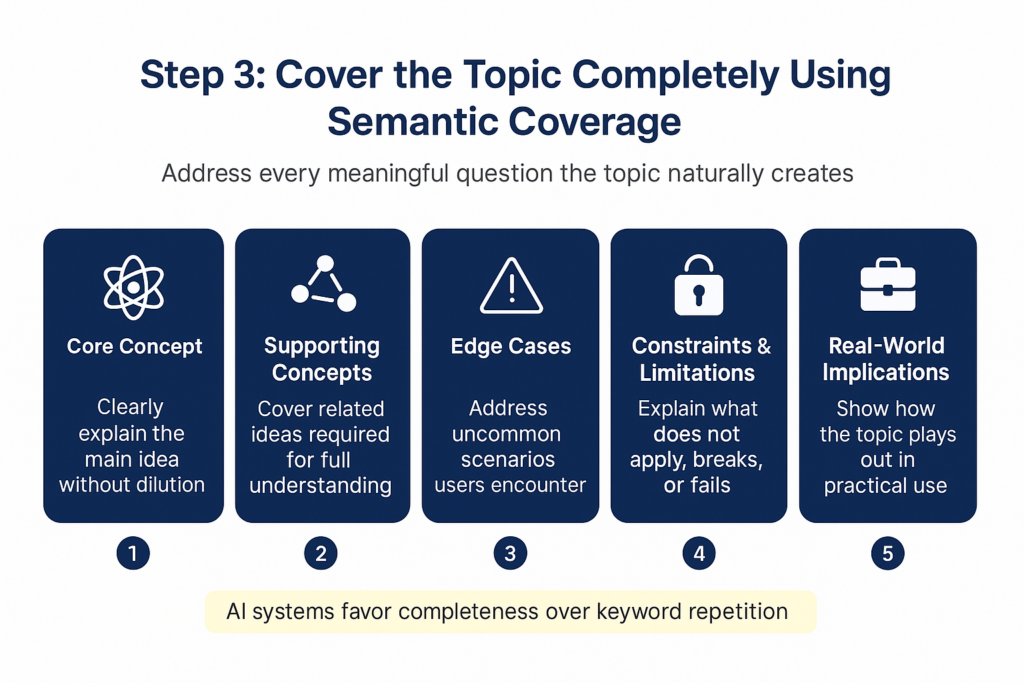
Semantic coverage means addressing all meaningful sub-questions that naturally arise once the main concept is introduced. This includes edge cases, limitations, and real-world constraints that most content avoids.
How to execute this step
- The core concept
- Supporting concepts
- Edge cases
- Constraints and limitations
- Real-world implications
Example:
A page about AI discoverability should include not only optimization tactics, but also where those tactics fail, such as weak entity consistency or conflicting definitions across pages.
Why this matters:
AI systems choose content that minimizes follow-up questions.
If your page forces a second query, it loses.
Most SEO content fails here because it avoids limitations to look positive. That is a mistake.
Step 4: Use a Clear Structure With Logical Flow
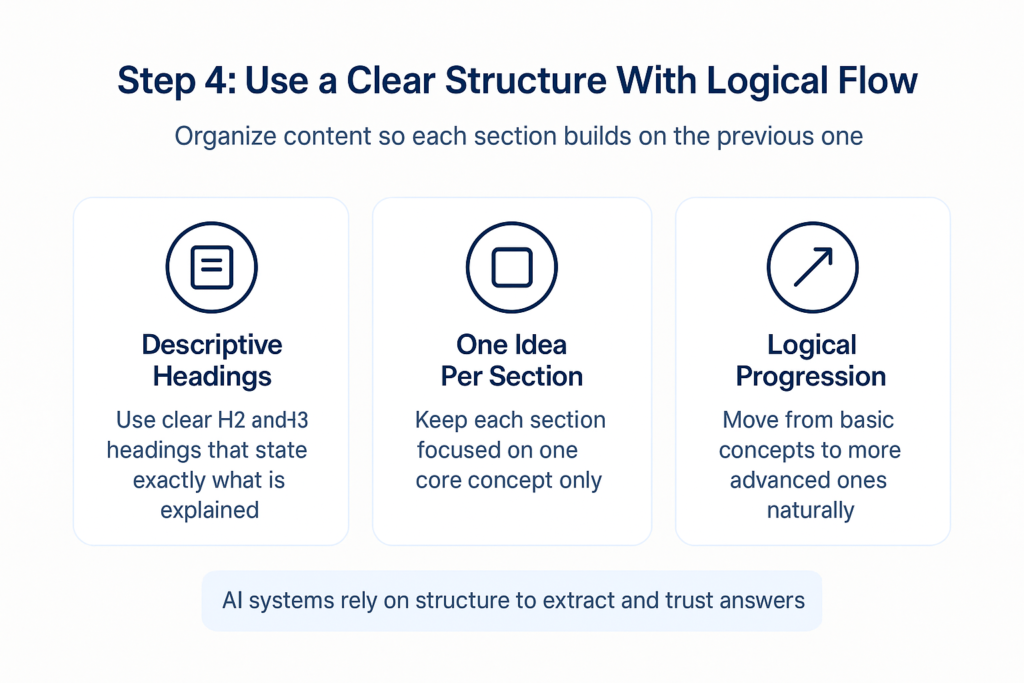
Clear structure means organizing content so each section builds on the previous one logically. Headings should describe exactly what is being explained, not act as creative hooks.
How to execute this step
- Use descriptive H2 and H3 headings
- Keep one core idea per section
- Move from basic concepts to advanced ones
Example:
Instead of a vague heading like “Why This Changes Everything,” use a descriptive heading like “How Structure Affects AI Content Extraction.”
Why this matters:
AI parses structure before meaning.
Poor structure lowers confidence even if the information is correct.
If your headings are clever instead of descriptive, you are hurting discoverability.
Step 5: Make Clear Claims and Explain Why They Are True
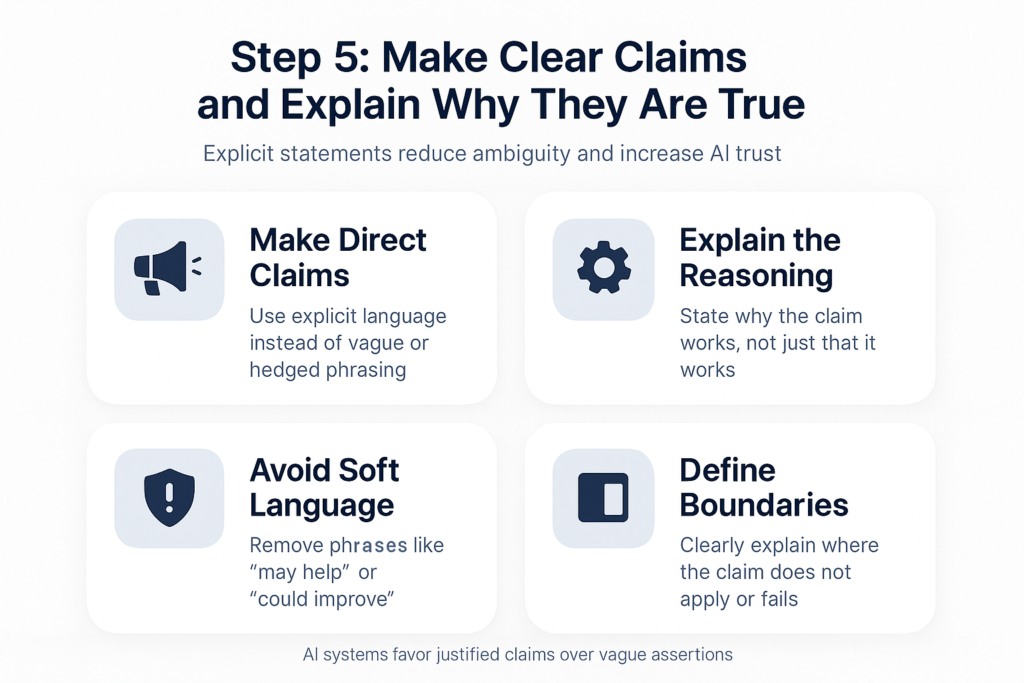
Every important claim should be explicit and supported by reasoning. Avoid soft language that hides responsibility. Clear claims signal confidence and reduce ambiguity during AI extraction.
Instead of writing:
“This can help improve results.”
Write:
“This improves retrieval accuracy when the primary entity is clearly defined, and related entities remain consistent.”
How to execute this step
- Make direct statements instead of hedged language
- Explain why the claim works
- Define boundaries where it fails
Example:
Rather than saying “this may improve visibility,” state “consistent entity definitions improve retrieval accuracy because AI systems rely on stable entity relationships.”
Why this matters:
AI systems prefer deterministic explanations over hedged language.
Clear boundaries increase trust.
Step 6: Write Every Important Statement to Be Quoted
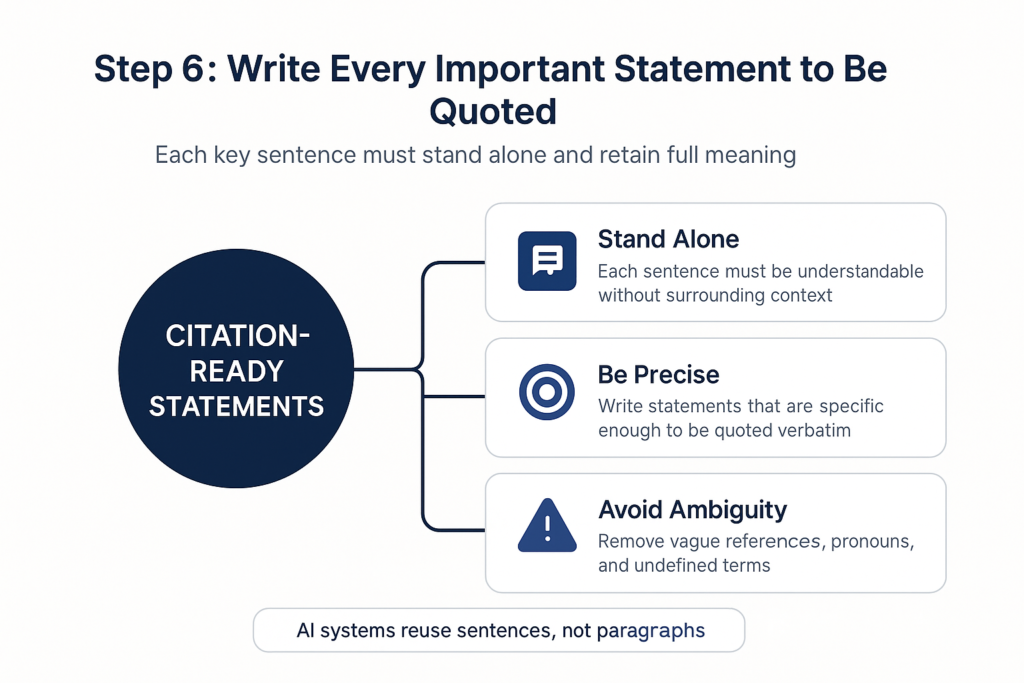
Citation-ready writing means each key sentence can stand alone without losing meaning. If a sentence requires surrounding context to be understood, it is unlikely to be reused by AI.
How to execute this step
- Stands alone without a surrounding context
- Be precise enough to quote
- Avoid ambiguous phrasing
Example:
A quote-ready sentence would be: “AI systems prefer content that completes intent without requiring follow-up queries.”
Why this matters:
AI systems will not cite content that risks misinterpretation.
If a sentence cannot be safely reused elsewhere, it will not be selected.
Step 7: Add Original Frameworks and Real Insight
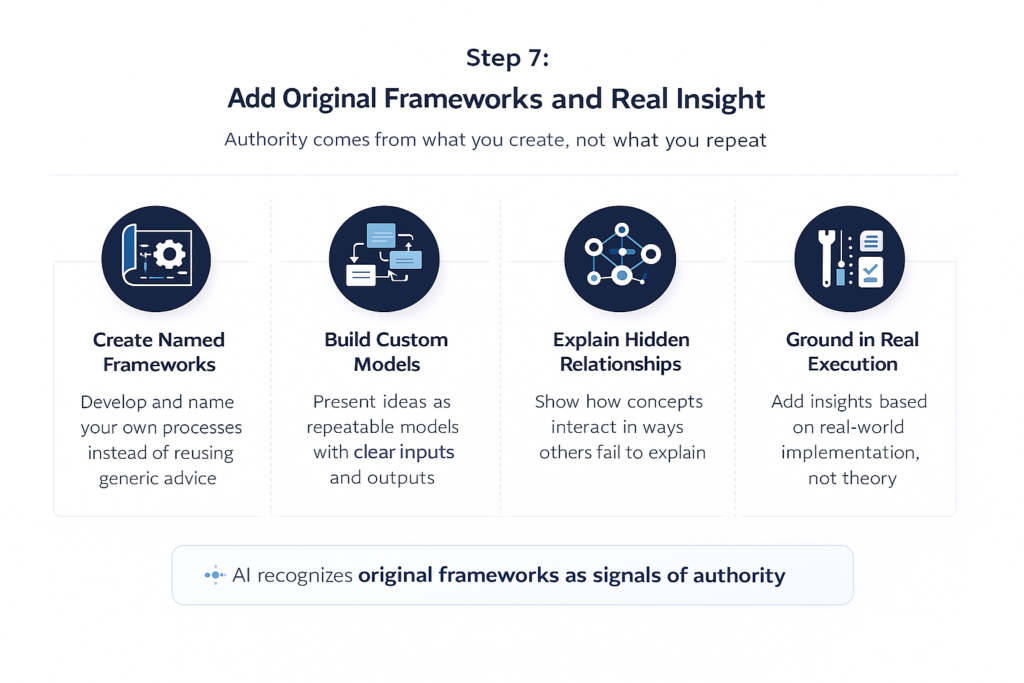
Originality is demonstrated through frameworks, models, or interpretations that do not exist elsewhere in the same form. Repackaging common advice does not create authority.
How to execute this step
- Create named processes or models
- Explain relationships others ignore
- Add insights from real execution
Example:
Naming and explaining a proprietary content evaluation sequence, such as Entity → Intent → Completeness → Extractability, gives AI systems something unique to associate with your content.
Why this matters:
Originality gives AI something unique to associate with your brand.
Generic SEO advice blends into noise.
Step 8: Build Trust by Explaining Constraints and Trade-offs
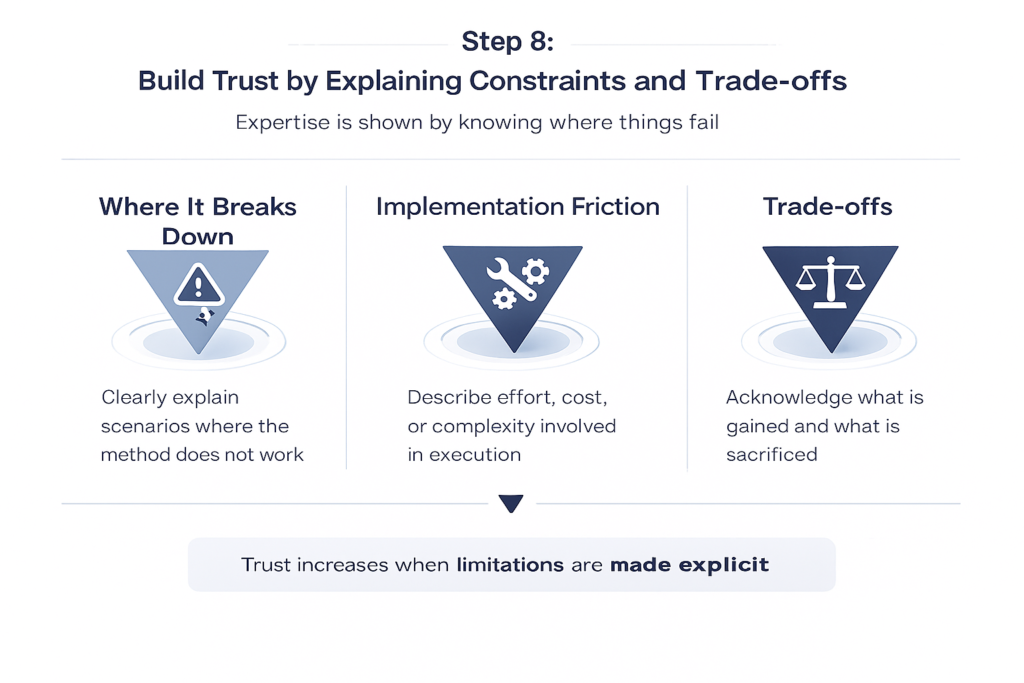
Real expertise includes acknowledging where methods break down. Explaining constraints signals experience and reduces overconfidence.
How to execute this step
- Explain where methods break down
- Describe implementation friction
- Acknowledge trade-offs
Example:
You might explain that even well-structured content fails when site-wide topical consistency is weak or when entities are used inconsistently across pages.
Why this matters:
AI can distinguish theory from experience.
Content that pretends everything works perfectly looks synthetic.
Step 9: Position Your Brand as a Topical Entity
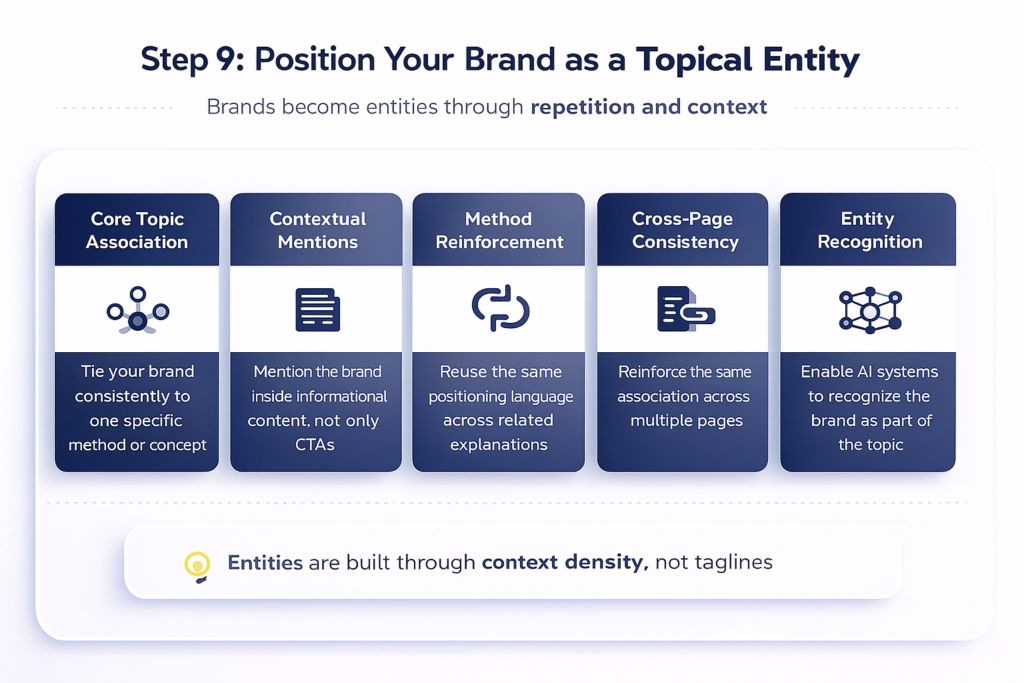
Brand entity positioning happens through repetition and context, not slogans. The brand must consistently appear alongside a specific method or concept.
How to execute this step
- Associate your brand consistently with a specific topic or method
- Mention your brand in an informational context, not just CTAs
- Reinforce the same positioning across multiple pages
Example:
Mention your brand in explanatory sections when discussing frameworks or methodologies, not only in calls to action.
Why this matters:
AI builds memory from repetition and consistency.
If your brand stands for everything, it stands for nothing.
Step 10: Format Answers Explicitly for Easy Extraction
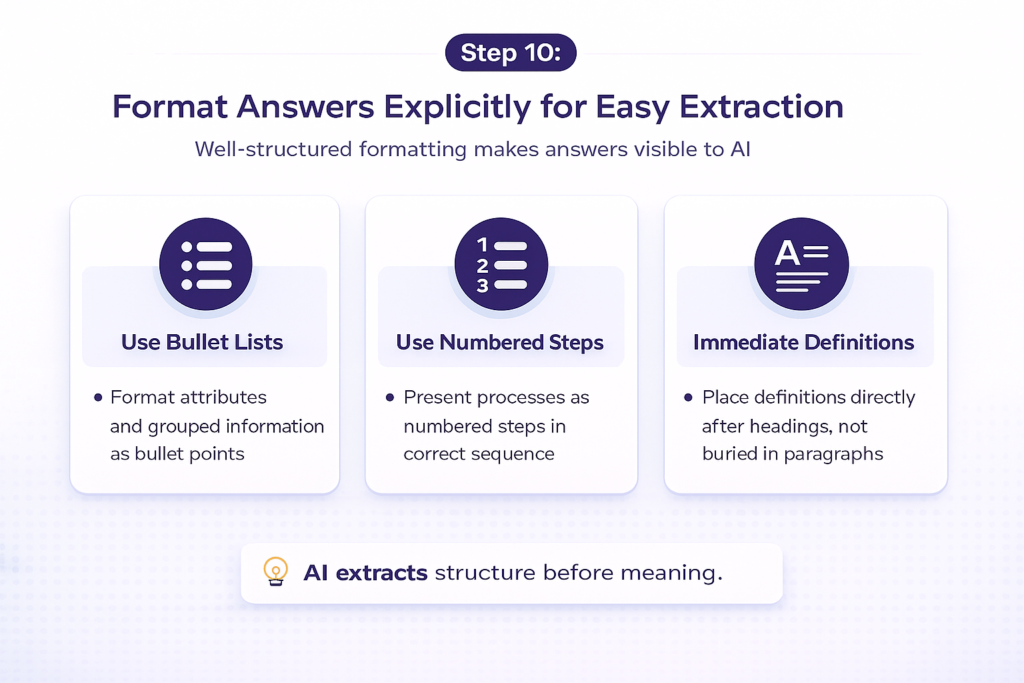
Explicit formatting helps AI systems extract answers accurately. Hidden answers are effectively invisible.
How to execute this step
- Use bullet points for lists and attributes
- Use numbered steps for processes
- Place definitions immediately after headings
Example:
Use bullet lists or numbered steps when defining processes instead of burying them inside long paragraphs.
Why this matters:
AI prioritizes content that is easy to extract accurately.
It does not infer. It extracts.
Step 11: Address Multiple Related Questions on One Page
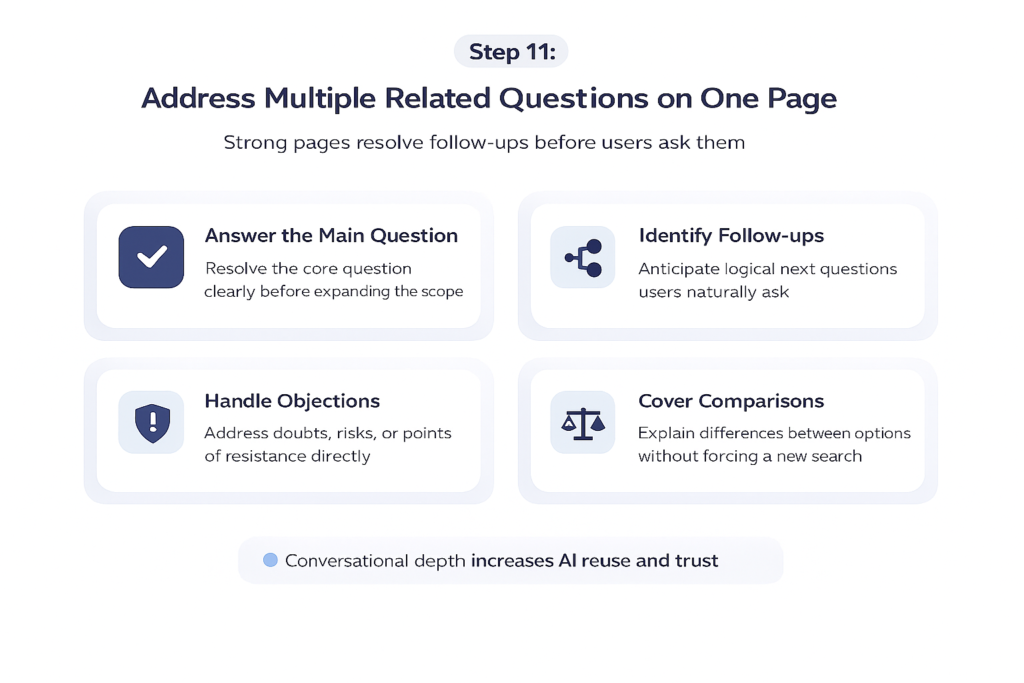
Strong pages handle conversational depth.
AI systems prefer sources that can answer the primary question and logically related follow-ups without forcing a new search.
How to execute this step
- Answer the main question first
- Identify natural follow-up questions
- Resolve objections and comparisons
Example:
For a page on AI discoverability:
- Explain what AI discoverability is
- Explain how it differs from traditional SEO
- Explain when AI discoverability tactics stop working
Why this matters:
AI retrieval is conversational.
Pages that handle conversational depth get reused more often.
Step 12: Use Language That Matches Natural Questions
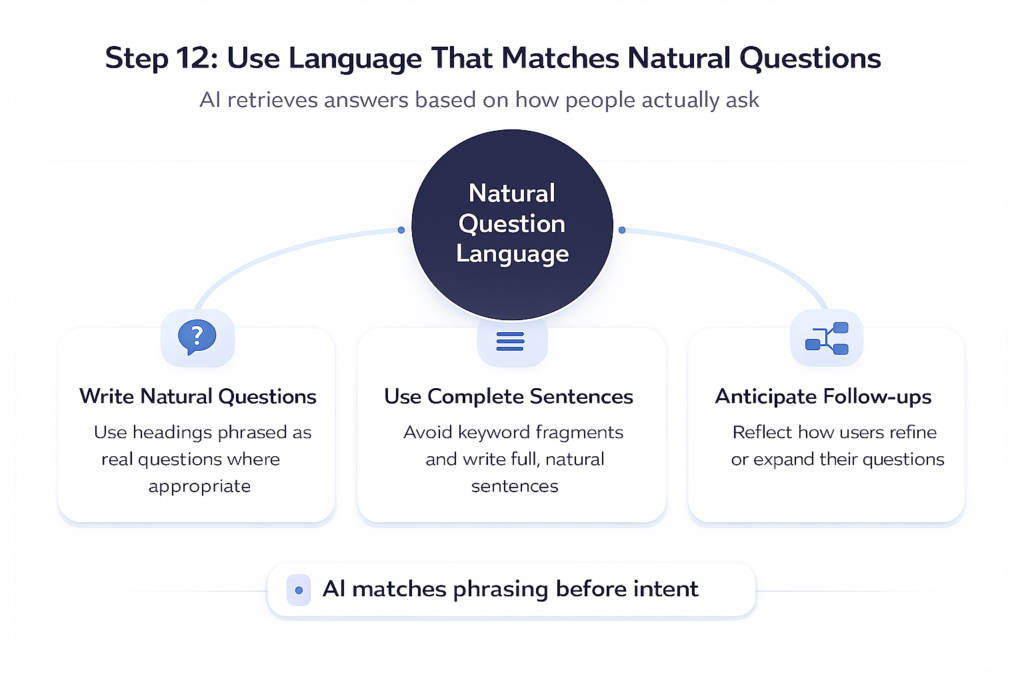
AI retrieval is conversational, not keyword-driven.
Content should reflect how real people ask and refine questions.
How to execute this step
- Write headings as natural questions where appropriate
- Use complete sentences instead of keyword fragments
- Anticipate follow-up phrasing
Example
- Use how AI decides which content to cite
- Avoid fragmented phrases like AI content citation factors
Why this matters
AI retrieval is conversational, not keyword-driven
.
Fragmented keyword writing hurts matching.
Step 13: Maintain Topical Consistency Across the Site
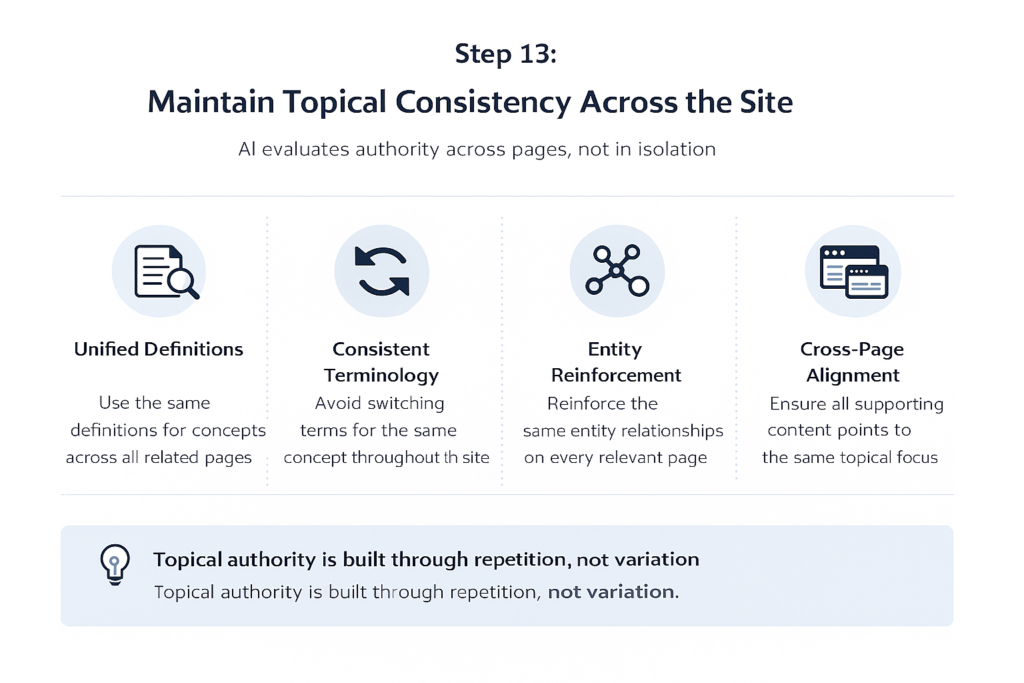
Pages are not evaluated in isolation.
AI systems assess consistency across your entire site to determine topical authority.
How to execute this step
- Use the same definitions across related pages
- Maintain consistent terminology
- Reinforce the same entity relationships
Example
If AI discoverability is defined one way on this page, do not redefine it differently on service pages or blogs.
Why this matters
AI evaluates topical authority at the site level.
One inconsistent page weakens the entire cluster.
Step 14: Update Content Only Where Facts Change
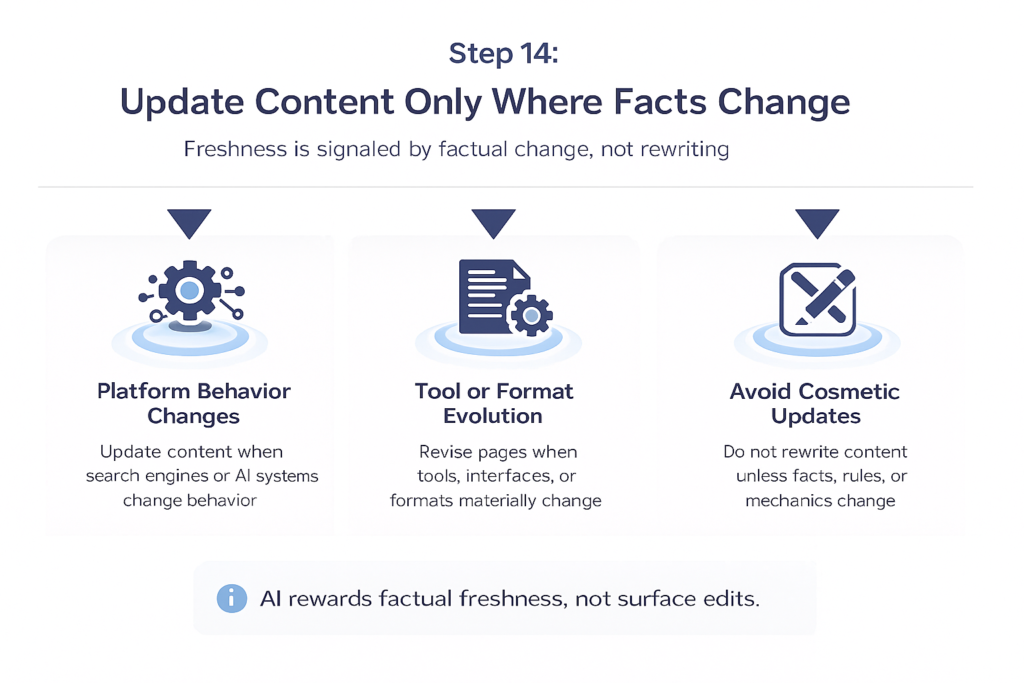
Not all updates improve trust.
Only factual updates signal freshness to AI systems.
How to execute this step
- Update when platforms change behavior
- Update when tools or formats evolve
- Avoid cosmetic rewrites
Example
Updating content after the new Google AI answer formats launch matters. Rewording sentences without new information does not.
Why this matters
Outdated facts silently reduce AI trust.
Evergreen does not mean untouched.
Step 15: Meet the Minimum Technical Requirements
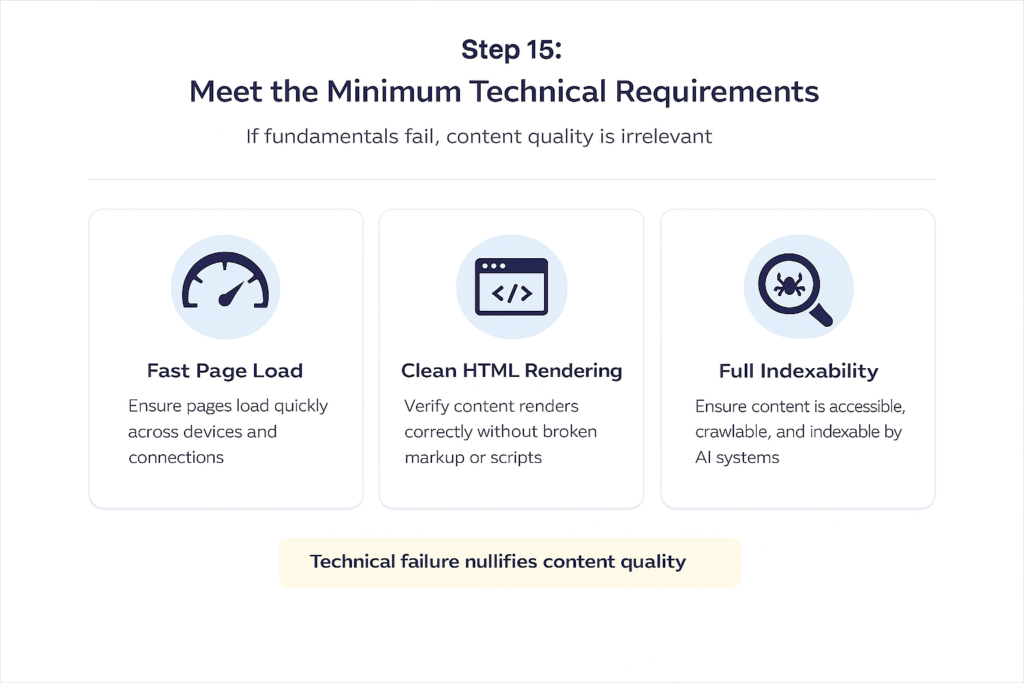
This is baseline, not optimization.
If technical fundamentals fail, content quality becomes irrelevant.
How to execute this step
- Ensure pages load fast
- Verify clean HTML rendering
- Keep content fully indexable
Example
If AI crawlers cannot reliably access or parse your page, even the best structured content will not be trusted.
Why this matters
If AI cannot reliably crawl your content, how will it be served?
Final Takeaway
AI discoverability is not about tricks.
It is about clarity, completeness, and confidence.
If your content:
- Defines entities clearly
- Completes intent fully
- Explains limits honestly
- Uses extractable structure
It becomes reusable.
And reusable content is what AI systems actually surface.
